
Teaching Financial Literacy at Te Awamutu Intermediate

How One New Zealand Teacher Has Used MoneyTime for Four Years to Build Confidence, Independence and Real‑Life Skills
When Jaime Johanson joined Te Awamutu Intermediate, she wasn’t actively searching for a new financial literacy program. It was a simple staffroom conversation that sparked the idea.
“I was talking about our maths program with one of the other teachers and she said she’d been using MoneyTime and that the kids really enjoyed it,” Jaime recalls. “That was enough for me to give it a go.”
Four years later, MoneyTime is a trusted and flexible part of her maths program, helping around 30 students each year build essential financial knowledge in a way that genuinely works in her classroom.
Fitting Financial Literacy Into a Busy School Day
At Te Awamutu Intermediate, MoneyTime sits within Jaime’s maths program. “In the classroom, it’s used as part of our maths sessions,” she explains. “They might practise their basic facts, work on tasks they need to catch up on or go onto MoneyTime.”
Jaime integrates MoneyTime fluidly across the year, most often on Thursdays but also whenever it fits. “Some weeks they might get five minutes. Other weeks they might get a full hour,” she says.
That flexibility is essential. Thursdays involve kapa haka, music lessons, extension groups and arts activities, meaning students constantly move in and out of the classroom.
That’s where MoneyTime shines.
“The kids can go on and do MoneyTime, that's their allocated time to do it. I like using it because students can leave for half an hour for other activities and come back in and just pick up where they left off,” Jaime says. “It means no one misses out. ”
“Some students hardly get any time some weeks, while others get heaps,” she says. “That’s why I like that MoneyTime doesn’t rely on everyone being at the same place at the same time. ”
A Student‑Led, Self‑Paced Classroom
Jaime’s approach is simple: unlock modules and allow students to work through them independently. Some move quickly. Others take more time, rereading and asking questions along the way.
That often leads to meaningful teaching moments. When students struggle with ideas or unfamiliar financial terms, Jaime pauses to explain, clarify and connect concepts to real life.
“I always remind them that it’s more important to understand what they’re doing than to rush through,” she explains. “If they don’t understand something, I want them to ask me or someone else in the class.”
Students also often support each other when needed. “They’ll work with a buddy sometimes, or kind of race each other,” she says. “Some of them are really into it.”
When confusion arises, Jaime brings learning back together. “If someone asks a question that shows a misunderstanding, I’ll often stop the whole class, even if not everyone’s up to that point yet,” she says. “It helps them later when they get there.”

A Choice Students Keep Making
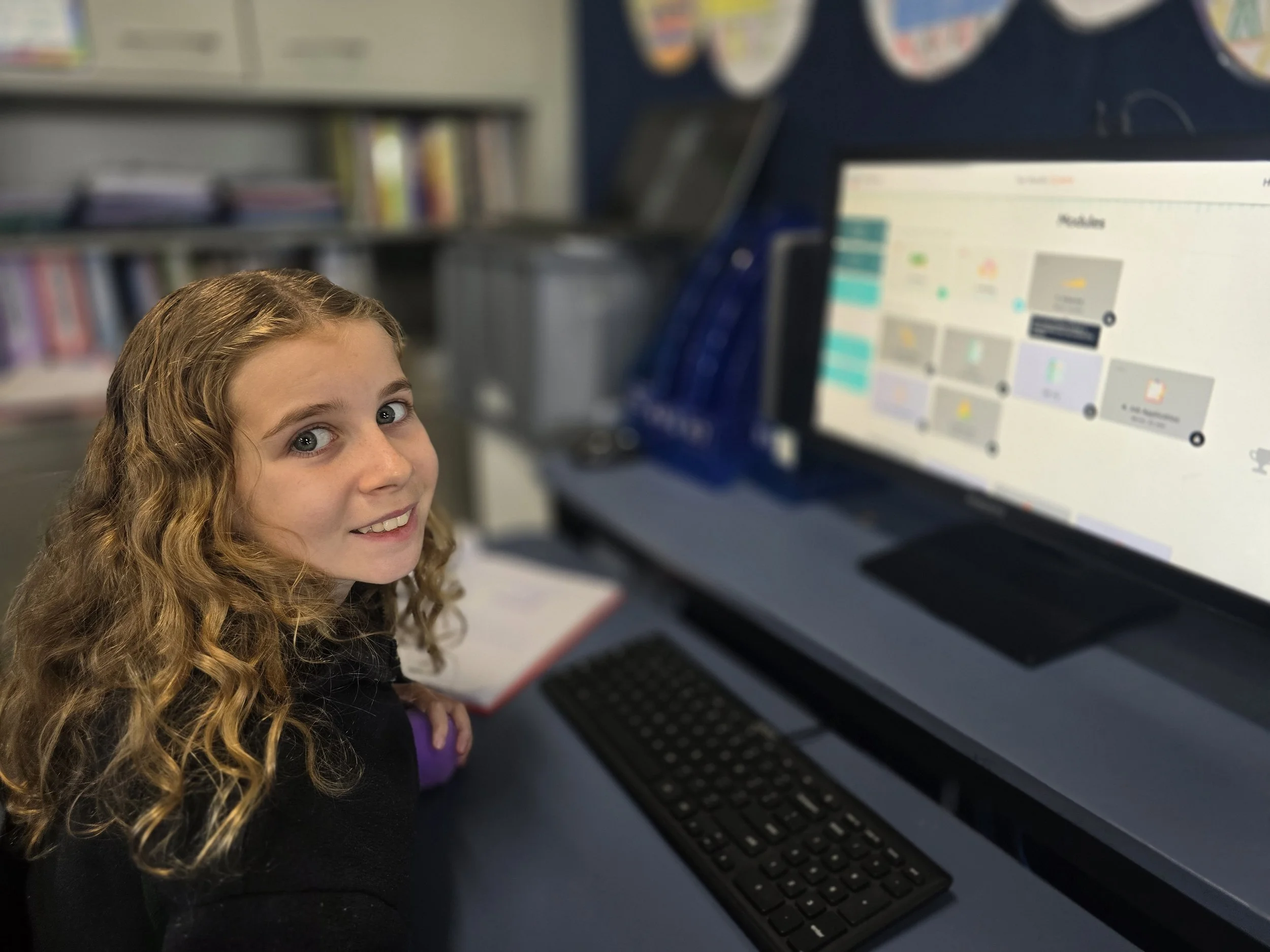
MoneyTime also works well as a reward and motivator. Students know that once they’ve completed their required maths work, MoneyTime is an option and it’s usually the option they choose.
“If they finish their work and ask what they can do, I’ll give them options,” Jaime says. “I might say, you can play a card game, read a book, or go on MoneyTime and they’ll make their own choice.”
Time and again, students choose MoneyTime. “They nearly always want to go on MoneyTime,” Jaime laughs. “But I’m clear, finish your work first.”
The program has also become something students advocate for themselves. “Before this interview, I asked them what I should say about MoneyTime and they said, ‘Just tell them we really like it!’ So I thought, oh, that’s good!”
Engagement That Lasts All Year
One of the clearest signs of impact is how students respond when MoneyTime is offered.
“They never groan and say, ‘Oh no, MoneyTime again,’” Jaime says. “When I tell them they’re going to do MoneyTime, they’re like, ‘Yeah, cool!’”
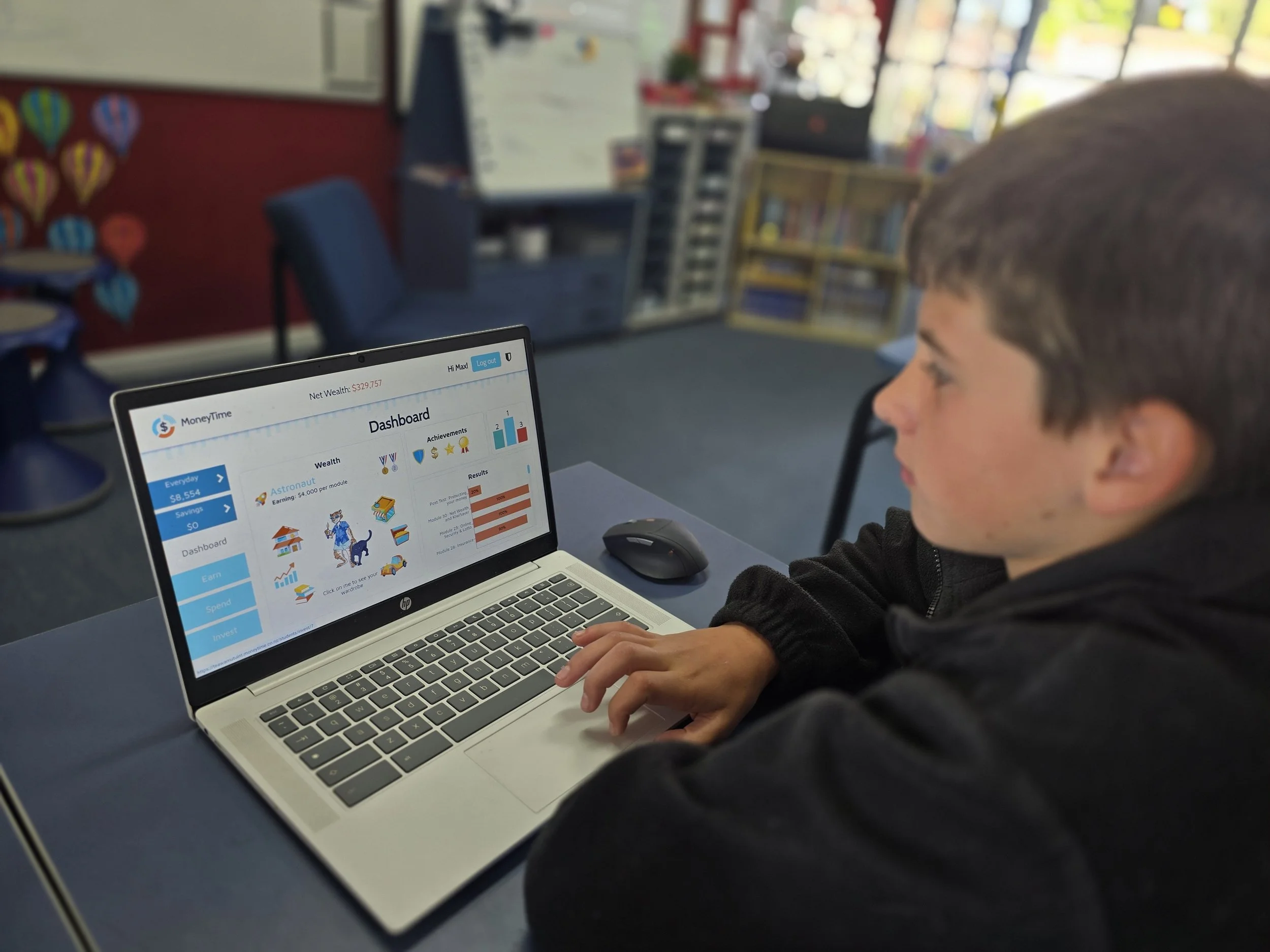
The platform creates its own momentum. Students enjoy personalising avatars, unlocking progress and racing ahead, often asking Jaime to open more modules because they’re keen to continue.
Encouraging Learning, Not Just Clicking
Jaime has noticed that some students are tempted to click quickly through reading-heavy content. She actively works against this.
“I try to discourage the click‑click‑click habit,” she explains. “If they don’t understand something, they need to slow down.”
She actually sees this reinforced by MoneyTime’s design, particularly the quizzes. “If they don’t pass the quiz and have to redo the module, that’s a good thing,” she says. “It shows they didn’t really understand it yet.”
Rather than seeing this as a frustration, Jaime frames it as accountability: learning matters more than speed.

Knowledge That Carries Beyond the Screen
The cross‑curricular links also reinforce understanding and make financial literacy feel relevant rather than abstract.
“I can see it in conversations,” she says. “When we talk about careers, when someone from the bank comes in, or when we cover other topics, I can say, ‘Remember when we did this on MoneyTime?’ and they make the connection”.
For Jaime, the value of MoneyTime goes far beyond engagement, it’s about preparing students for life. “No matter what they do in life, they’re going to need real financial skills, even basic ones. So, how will they cope in the world if they’ve never been exposed to this?” she adds.
Even when some concepts go slightly beyond students’ current understanding, she sees value in early exposure. “Even if some parts go a bit beyond their understanding, they’re still being exposed to it,” she explains. They’re learning the language, the ideas, before they get to the stage where they’re applying for jobs or managing money themselves.”
Aligned With the New Zealand Curriculum
Jaime also sees MoneyTime as a strong match for curriculum expectations. “We’re only required to spend a small amount of time on financial literacy,” she explains. “MoneyTime more than covers that and sets students up really well for high school.”
Easy, Reliable and Built for Teachers
A key reason Jaime has continued using MoneyTime for four years is its simplicity and reliability.
“I’ve never had any issues getting set up,” Jaime says. “And if I ever have a question, I just email and get a quick response.”
That ease matters in a busy classroom environment.
“Sometimes with other tools, you get glitches or you can’t log in and that’s frustrating as a teacher,” she explains. “When things are hard to use, you give up on them. That’s never been the case with MoneyTime.”
This simplicity has led Jaime to confidently recommend the program to other teachers over the years.
Jaime’s Advice to Other Teachers
When asked what she would say to other New Zealand teachers considering MoneyTime, Jaime is clear:
“It’s easy to use, easy to set up and the support is great. The kids love it and that motivation to get ahead or unlock more modules really drives them. Most importantly, it helps them learn skills they’ll actually need in life.”